Category Archives: CS-448

Your First Language

For this week’s blog post, I have decided to look at the apprenticeship pattern “Your Fist Language”. The idea of this pattern is when you first start your programming journey. This is when you only know one or tow languages. The main concept of this chapter is to isolate what langue you would like to use as your main language. According to Dave H. Hoover and Adewale Oshineye, the authors of the book, they say on this, “Pick a language. Become fluent in it. For the next few years this will be the main language you use to solve problems, as well as the default skill you hone whenever you are practicing. Making this choice is a challenge. It is important that you carefully weigh the options, as this is the foundation upon which your early career will be built.” (Dave H. Hoover & Adewale Oshineye).

When first reading about this pattern, it really grabbed my attention. At Worcester State we learn an abundance of different languages to be able to be prepared for the outside world. However, something that has always been a question for me is “What language do I stick with?”. What was cool about this chapter was that it said to have a main language under your belt, but it never said to toss aside the other languages. As an example, they talked about a job requiring a specific language to be able to be hired there. Rather than disregarding the job and looking for something else, they suggest making a toy application to learn a basic understanding of that language. Some of these toy programs will involve a problem to solve. Unlike a simple “Hello World” application, solving a problem will give you a more in-depth dive of the language. Another good thing to add to your toy application is a test class. Test classes always help ensure that what you are coding is spitting out the correct information.

With this chapter in the book, I agree with everything that they are saying about your first language. I loved how they talked about having a min langue but not disregarding the other languages you have learned or will learn.  It also made me consider more what will be my main langue when I go out into the field and what language I’m willing to put more research into.

Book: Apprenticeship Patterns, Dave H. Hoover & Adewale Oshineye

From the blog CS@worcester – Michale Friedrich by mikefriedrich1 and used with permission of the author. All other rights reserved by the author.
The Deep End

Months ago, I found myself standing in “The Deep End” since I wasn’t able to land any internship before graduating this year. The situation was exactly the same as how they described in the book, I needed to grow more skills, my confidence, and my portfolio of successful work, I needed to challenge myself with bigger works, projects, complex tasks, and teams, etc. The YouTube algorithm even made my situation worse by showing people about my age are “better” coders than me in my opinion. I was afraid that I did not do “enough”.

 Currently, what I really felt at that time was envious, seeing people better than me virtually is rough but seeing people who I know landed works while I carried them through classes is overwhelming. My resume, my ability, my confidence, all of them were kind of irrelevant at that point. I created an invisible time limit for myself to be successful, to this point, I still think there are pros and cons to doing it, the risk could be high but I take it.

Later, exactly in how they advise the action, I should instead jump into working on projects that I did not do to create a time limit for it, I’m willing to take more work than anyone in the team and fulfill my responsibilities to not only build my portfolio but also my skills and my confidence. Then, after a while, I will analyze my set of skills fit to what role in the industry and pick the right opportunity based on it.

Besides, when this post is online, I’m currently handling an internship and a capstone project in which I volunteered to be the Scrum master that instead does not make me feel overwhelmed but motivated, as I am learning new materials every day.

In conclusion, it likes how The Deep End was described in vol. 15 of “Diary of the Wimpy Kid: The Deep End”, which follows Greg Heffley’s summer story, a dramatic summer yielded great memories, things could be tough initially, but if I keep continuing on this track, hopefully, the result will be what I aimed.

From the blog CS@Worcester – Vien's Blog by Vien Hua and used with permission of the author. All other rights reserved by the author.

Sprint Retrospective – Sprint 1

For the first sprint of the semester, I individually didn’t get as much done as I hoped to. I did help others, and collectively as a team we got a good amount done,  but I hoped to get more done individually. For this first sprint, I spent a lot of time looking through the project and the different repositories to find out about each component, how it worked, and how it interacted with the other components. Due to this, I feel that I learned a lot about how the project currently works, how it’s supposed to work, and what systems currently function or do not function. However, this also means that I didn’t have a lot of completed tasks.

The only issue that I had assigned myself on GitLab was the one to rename the subprocess files in the Reporting Backend. We felt that the names ‘send.js’ and ‘receive.js’ weren’t very descriptive, and in order for them to properly reflect what they were for, they would need to be renamed to something more descriptive. This sent me down a rabbit hole of looking through the project files to see everywhere the files were referenced so that nothing would be broken by renaming them, and also to be able to update the names in any documentation in which they were referenced. This led me to discovering that many things in the project were pulled from an old version of the backend, and that many things would have to be redone in order for it to pull new changes and build the image from the new repository. Additionally, I noticed that there were two sets of send and receive files, one in the subprocess folder of the backend, and one in the RabbitMQ folder. This had me very confused, as I at first didn’t know what the send file was for because our module wouldn’t need to send any information through the queue system, but then I discovered that it was simply to insert dummy test data into the queue for it to be received by the backend. I still don’t fully understand why there are two sets of these files, but I now understand what they’re for and will be able to modify and use them.

What worked well within our team was everyone being individually proficient, as well as being proficient in certain areas that others were not. Everyone on the team had their own strengths and weaknesses, and we were able to coordinate so that people’s strengths complimented each other, working towards a more cohesive whole. For example, I am more knowledgeable about the backend systems more so than the frontend systems, so I know more about how the docker containers work and some JavaScript, whereas others know more about Vue and the design of the frontend and are much more proficient than me in JavaScript.

What didn’t  work very well was our team communication. We communicated mostly only in class, and only minimally out of class such as on Discord. Given that we were all individually proficient, we had less of a problem completing tasks individually, meaning we had less of a reason to communicate what we were doing and what progress was being made. I think that sharing more information with other team members periodically, such as what progress has been made, what you’re working on, and what still needs to be done, outside of the scheduled times, could have been very productive and helpful for the team.

To improve upon this, we could have scheduled times for meetings outside of class via Discord, where we could discuss the details of what each of us is currently doing and ask others if they need help or if we need help. This way, we could more immediately resolve an issue that someone is facing, rather than having to wait until the next class to discuss the issue with the other team members. Additionally, the extra time spent as a team could help us to figure out each other’s strengths and weaknesses, and to discuss how we could work better as a team.

Individually, I could have improved upon a few things. First, I should have focused more on completing certain tasks, rather than exploring the project independently of any tasks. I could have learned everything I did about the project while completing tasks, rather than without completing tasks. Second, I could have better shared what I learned about the project with other team members.

From the blog CS@Worcester – Alex's Blog by anelson42 and used with permission of the author. All other rights reserved by the author.

The White Belt

The apprenticeship pattern I’m going to be looking at today is called “The White Belt”, from chapter 2.

The use case for this pattern is when a programmer has reached a point in their development where the rate at which they learn new information has begun to decline. The proposed solution is to hold on to newfound confidence while setting aside newfound knowledge. This way the new knowledge has time to sink in before it is synthesized with old knowledge, allowing new information to flow more easily.

I liked the example brought up here of Dave, a therapist. He found greater success with his clients after approaching his clients with as few assumptions and as much curiosity as possible. I feel that this demonstrates that this is a useful general principle for learning, rather than just one for learning about technology. This is why I find this idea compelling.

Something I found insightful in a more practical way was the idea of suspending the use of idioms you are familiar with in favor of the ones that are considered “best practice” for whatever tool you are using. Even if you don’t necessarily agree with, for instance, the concerns that Java programmers focus on, understanding the community around a language is essential to understanding the language itself. “Emptying your mind” in this way can be especially helpful the more unfamiliar you are with the language you are using, like if you were moving from a procedural to a functional language, for example.

I think that with technology fields in particular, there is immense pressure to be perfect, or at least exceptional. It can be extremely difficult to sacrifice productivity for benefits that are not immediate, and even more difficult to risk looking like you don’t know what you’re doing. Still, this is a leap of faith one must take to be good at what they do. Having it said so clearly makes it easy to see my hesitation as kind of silly.

I think I’m also going to add the book mentioned at one point, “Working Effectively with Legacy Code”, to my reading list. Not much was said about it, save for the effect it had on one reader, but it sounds like something that I, personally, would be really interested in. 

Another thing I’m going to try at some point is the exercise about rewriting a program with different idioms. I want to take something very simple I wrote for practice once, like a program that converts between temperature units, and rewrite it in a completely different language with idioms that are totally unfamiliar to me. I’m not really used to caring about idioms in this way, so I feel like this is the next big step forward I can take as a programmer. 

From the blog CS@Worcester – Tom's Blog by Thomas Clifford and used with permission of the author. All other rights reserved by the author.

Sweeping The Floor Learning Pattern

This pattern is very important it tells us how to begin the career switch from student to paid professional. It is a scary moment of unprecedented uncertainty. It helps us see with a clearer image that there are levels of expectation. These expectations are stratified to build a path to success. It also throws cautionary tales of getting comfortable doing the work at the outer layers of what’s expected.

This is very personal because everyone of us graduating will face the reality of a professional environment. I could not say that it will be harsh or easy. What I can say is that the expectations and anxiety that we generate ourselves is harsh. It makes me feel better to think that the professional world in general has a path in which one can climb, even if this path is steep. The great fear is that there is no path, the goal is the space station, and you don’t know how to build a rocket.

Putting my trust on the writers I expect this sweeping the floor pattern a practiced reality in real situations. I don’t believe there are any menial tasks. All tasks must be completed, and I wouldn’t mind if I had to do some of them or even all of them if it’s all I can do. I have used this pattern in my own life differently. When my car brakes I usually fix it myself because I can not afford the extra expense, this is something that I really don’t want to do. It takes time away from my studies, but it also helps me afford it. Some people say why should they pay a mechanic x amount for only an hour of work but the amount it would take a normal person without the tools and environment would much offset whatever savings they think they had. Most of the time I think if I had the money, I would pay double for a professional to do this for me.

You learn the cost of doing something by doing things you wouldn’t necessarily want to do. Sweeping the floor may begin with doing the easy undesirable work but it must progress into doing work you are uncomfortable with. Success in life comes when you accept uncertainty and never get too cozy as to be paralyzed by extraneous events.      

From the blog CS@Worcester – technology blog by jeffersonbourguignoncoutinho and used with permission of the author. All other rights reserved by the author.

Apprenticeship Patterns: Finding Mentors

We all have people we look up to, those who we see as guiding lights in the unpredictable lives we all live in. These special few, these mentors can be anyone, from friends, to family, to anyone in between. Having a mentor does wonders to the process of learning as well as providing a source of motivation and consultation when you find yourself struggling or at a dead end.

In ‘Apprenticeship Patterns’ by Hoover, Dave H., and Adewale Oshineye we see the pattern of seeking mentorship described in detail. Consider being an inexperienced software developer who has run into dead end after dead end while developing a new piece of software. Often we turn to those more experienced than us for insight into our problems and this case is no different. We seek out anyone who has had a similar issue and ask what they did in that situation.

Finding a master craftsman and learning from them is the goal of all aspiring apprentices and an ideal that we all seek. This however is often very rare today so many of us will find mentors who we can gather advice from regarding their own past experiences. Our field is relatively young and often changing, leaving few master craftsmen to teach those who are just starting out. Along with this many of these masters may not be physically available to you. This is where the mentors arrive to fill in the gaps.

Weather they are a coworker, a dear friend, or an anonymous individual online, a mentor can mean the difference for many software developers out there. They can offer insight on their prior experiences that may mirror your own, expose you to new ways of thinking, or just offer genuinely good advice. It is just another way to break your coding block when you find yourself stuck with a nonfunctional or misbehaving program you are attempting to get working.

With that said however, we all ‘walk the long road’ at the end of the day (Apprenticeship Patterns Ch 3). and finding someone to guide you can be hard so I will leave you with a recommended course of action by the authors. Find a library, or community with an active mailing list and being observing any messages left there. Over time you will pick up on the values of the community and which members are patient and willing to teach others. At the next opportunity, seek them out and establish that first connection with them in order to see if they would be interested in offering any informal advice or lessons they have learned over their time.

Bibliography:

Hoover, Dave H., and Adewale Oshineye. Apprenticeship Patterns: Guidance for the Aspiring Software Craftsman. O’Reilly, 2010.

From the blog CS@Worcester – George Chyoghly CS-343 by gchyoghly and used with permission of the author. All other rights reserved by the author.

Week 2: Apprenticeship Pattern Chapter 2

For this week’s reading, I decided to read the pattern ‘The Deep End’ in Chapter 2: ‘Emptying The Cup.’ The context was taking small safe steps has led to unsatisfactory progress and has lead to not a plateau, but a rut. In a rut, it’s worse than a plateau, your competence decays into mediocrity. The problem is you need to progress your skills, your confidence and portfolio. Already, I began to relate to this pattern because I’ve fallen into the trap of being complacent with my skills and not ‘honing my craft.’ It’s a pretty bad place to get stuck in, I really would not recommend falling into this trap. For someone like me, it was really hard to get out of this spot in my life, even now I still feel like I’m plateauing, maybe even in a rut, but the first step to preventing this is to be proactive and push yourself.

The solution was practically the same thing I just said before, to push yourself, jump in the deep end. Basically, try to take the high risk high reward tasks in life that will significantly push you toward a higher knowledge is how I interpreted this pattern. Pushing yourself too hard will only set you back and you won’t have a significant enough takeaway from that high risk task you did. To which I agree with, although I can’t say that I have put
into practice this solution in my life yet. I have been too complacent for too long, it was only recently that I decided to try and push myself. The mental setbacks with myself make it very hard to push through and gain that knowledge that I seek but can’t perserve to but every day I try to tell myself that this is the day.

As for the action for this pattern, it basically says to write your projects down in a chart to path how your career is moving in complexity. At least,
that’s how I saw it. To be honest, I didn’t know what the action meant, I thought it was a second solution but after reading this it kind of makes sense to me but
I still don’t understand it. Perhaps I should put it into practice to see how my progress is going.

From the blog CS@Worcester – Brendan Lai by Brendan Lai and used with permission of the author. All other rights reserved by the author.

Craftsmanship Log #1 – My First Language

In the first Craftsmanship post I made, I mentioned that I am reading through Hoover and Oshineye’s book named “Apprenticeship Patterns”, which outlines certain patterns that inexperienced software developers may adopt so that they may overcome any potential hurdles during their personal learning experience rather than providing technical solutions. In fact, in that very post I mentioned (though not by name) two of such patterns, namely “Craft over Art” (introduced in chapter 3) and “Record What You Learn” (introduced in chapter 5). Though I may expand on these two particular patterns in a later post, I want to first address my reactions to one of the very first patterns that are introduced in the book, namely “Your First Language”.

            Briefly put, “Your First Language” is a pattern that is meant to address a software developer’s potential issues that may arise due to the fact that, though they may know multiple languages, they lack sufficient fluency in one of them. As such, such lack of fluency may put the developer in a difficult position when they are needed to work on a project that needs to be in a specific programming language. In this case, the book suggests picking a specific programming language to learn and master, preferably one that is used by any experts one might know. Now, it is important to specify that “learning a language” is not simply achieved by reading some resources related to a specific language, but by using that language to solve problems and actually apply what has been learned. Thus, by continuous application, a software developer may hone their problem-solving skills, which then may help them in learning other languages as well.

            While I personally found this pattern to be particularly helpful when I first started studying Software Development, I feel like my experience has changed the way I approach specifically learning a programming language. Though becoming fluent in a language is important, I believe it is also important to be proficient in the learning process itself. In my case, while I was learning my first language, I also made sure to internalize what that language was composed of in terms of concepts and structures I could use so that, when there is a need for me to switch to a different language, I would have some expectations as to what concepts I should expect to encounter and only worry about syntax while learning the new language.

From the blog CS@Worcester – CompSci Log by sohoda and used with permission of the author. All other rights reserved by the author.

Find Mentors

Self-learning is one important quality of any programmer; however, self-learning is not always useful since the learner might not know what is waiting for them and if their approach is good or not. In this case, every learner needs mentors, those who already achieved what we are working on or at least, they have deeper knowledge about the topic that we are learning.

“Whether a beginner starts out with a training course or is self-taught, the first step on the path to software craftsmanship is finding a craftsman to apprentice himself to”

–Pete McBreen, Software Craftsmanship, p.96

From my own experience, I find this statement can’t be more accurate as I find myself learning more productive when I have mentors to show me what I should do compared to learning by myself. However, as in the book illustrated, as an apprentice, it can be difficult to tell who is truly a master craftsman. Therefore, an apprentice should follow a set of mentors that each one will show them a bit of a huge picture. And the set of mentors here counts not only “real” people who we should have already considered them as our mentors to learn, our friends and our professor, but also the active community we could find online to exchange information with people on it.

Besides, according to what was written in the book, an apprentice shouldn’t expect their mentors to know everything and get disappointed if mentors don’t know what we are seeking for as the current mentors could be other’s apprentice, we are all walking on a long road. Because our field is huge, a person who can guide us through 10 in-built React hooks may not be able to show you how to design the API route and vice versa, these twos are completely different topics and what we probably need is to master a specific set of skills that we desired; but it’s obviously the more we know, the higher opportunities we’ll have.

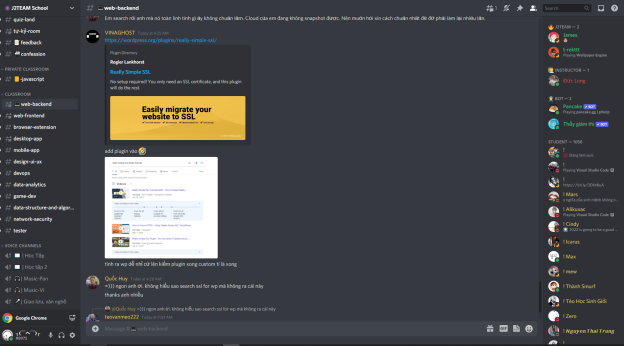
In conclusion, what I learned from this chapter is that I should find a community and actively communicate with other members there. Luckily, I found myself on a discord channel of one of the biggest Vietnamese tech forums, J2Team, having a community of developers exchanging lots of quality contents.

A channel in J2Team server

Now, I should consider posting my first message here and seeing where it will lead me to. 

From the blog CS@Worcester – Vien's Blog by Vien Hua and used with permission of the author. All other rights reserved by the author.

Chapter 3: Walking the Long Road

This chapter has talked about how to start your career with low expectations if none at all. For example, Gustav Mahler, musician and composer has talked about the life of Dave in his career. As I paraphrased like this: Dave had his own cubicle and, despite having even less experience than he does today, he kept a stack of certifications by his desk. The stack began with a Perl “master” certification from Brainbench and grew to include certificates demonstrating he had completed multi day trainings in C, J2EE, Vignette, and ATG Dynamo. This modest stack of pseudo parchment comforted him (and his organization) that he was in control of his situation. He’d been “schooled.”

Meanwhile, through http://perlmonks.org and the comp.lang.perl.* newsgroups, Dave had begun to expand out and communicate with the broader developer community. It was in these groups that he met some of the best Perl hackers he’d ever met. The hackers’ knowledge was intimidating, especially because Dave could tell that they were still learning and learning quickly. It seemed to him that he had just begun to scratch the surface of what it took to be a great software engineer. His stack of training certificates gradually vanished beneath a greater mound of scratch paper and printouts of book drafts and lessons during the next few months.

Dave was captivated by the learning process after observing and interacting with a couple of these excellent hackers. Periodically, he’d catch a glimpse of the hackers’ expertise and be either disappointed or inspired—discouraged by how little he understood yet inspired by the force of these hackers’ abilities. He got into side projects and started reading everything he could get his hands on.

The more Dave knew, the clearer it seemed that he still had a long way to go. Over the next few years, he had the wonderful opportunity to work with some excellent software developers face to face. Even though these extraordinary people were miles ahead of him, Dave saw that they were all on the same path.

The Long Road

There are many different patterns that resonate to me, but The Long Road is the best one to me because it explained what type of expectations you should have when you want to be a master software craftsman, but your ambitions are at odds with what others expect of you. Rather than gradually improving your skills, conventional wisdom advises you to take the highest-paying job and the earliest promotion you can get, to stop programming and move on to more important work. Accept the possibility that you will be perceived as odd for what you desire to become. Second, maintain a long-term perspective. Prioritize learning and long-term growth prospects over money and traditional ideals of leadership throughout your apprenticeship.

From the blog CS@Worcester – Site Title by proctech21 and used with permission of the author. All other rights reserved by the author.